
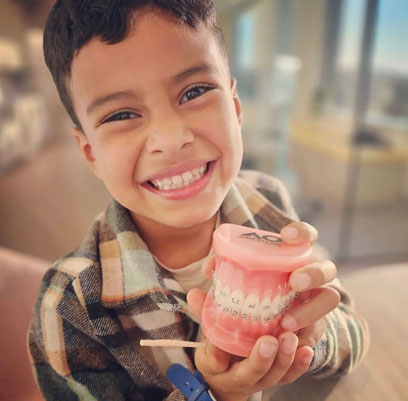
Does your child sleep with their mouth open? You might assume it’s harmless. But chronic mouth breathing can actually reshape your child’s face and jaw in ways that affect their smile, sleep, and overall health for years to come. It’s one of the most overlooked issues in early childhood development, and most parents have no idea it’s even on the radar of pediatric dentists.
The good news? When caught early, these changes can often be guided back on track. Here’s what parents need to know about mouth breathing and jaw development.
What Is Chronic Mouth Breathing in Children?
Chronic mouth breathing is a habitual pattern where a child breathes through the mouth instead of the nose, during the day, at night, or both. Unlike occasional mouth breathing during a cold or hard exercise, the chronic version persists for weeks or months and can quietly influence facial growth, sleep quality, and oral health in growing little smiles.
Several factors can trigger this pattern. Enlarged tonsils or adenoids are common culprits. So are allergies, chronic congestion, and tongue or lip ties. When the nasal airway is blocked or restricted, the body adapts by breathing through the mouth.
A notable share of children experience some degree of chronic mouth breathing, especially during the early growth years when allergies and enlarged adenoids peak. Watch for these signs:
- Open mouth posture throughout the day
- Snoring or noisy breathing during sleep
- Dry, cracked lips
- Drool marks on the pillow
- Frequent throat clearing
If you notice several of these signs, it’s worth having your child evaluated. What looks like a simple habit may actually be affecting how their face grows.
How Mouth Breathing and Jaw Development Are Connected
Mouth breathing reshapes a growing child’s face by altering tongue position and jaw mechanics. When kids breathe through the mouth instead of the nose, the tongue drops away from the palate, the upper jaw narrows, and the lower jaw rotates downward. Over time, the face elongates and the chin recedes. This is the heart of how mouth breathing affects jaw development in children.
When a child breathes through their nose, the tongue naturally rests against the roof of the mouth. This gentle pressure acts like a natural mold, helping the upper jaw grow wide and strong. Lips stay closed, and the lower jaw stays in proper position.
Mouth breathing changes everything.
With the airway compromised, the tongue drops down and forward to keep things open. Without that tongue pressure on the palate, the upper jaw narrows. A high, arched palate develops. Teeth crowd together because there’s simply not enough room.
Meanwhile, the lower jaw rotates downward and backward. Faces lengthen. A weak or recessed chin starts to appear. Many little smiles also develop forward head posture, with the chin jutting out and shoulders rounded, as their body works to maintain an open airway.
Dentists and orthodontists sometimes call this pattern “long face syndrome” or “adenoid facies.” These changes accelerate during peak growth years, typically ages 4 through 12. That’s why early detection matters so much. Once growth plates close, correcting these structural changes becomes far more complex.
Why Early Intervention Matters
Tackling mouth breathing while your child is still growing offers real advantages. Young bones are malleable. Jaws are still developing. The body responds well to gentle guidance.
Benefits of early treatment include:
- Guiding proper jaw growth while bones are still soft and responsive
- Reducing the likelihood of tooth extractions or jaw surgery in the teen years
- Better sleep quality, which supports focus, mood, and behavior during the day
- Helping kids develop healthy tongue posture and natural swallowing patterns
- Preventing or reducing sleep-disordered breathing issues
- Solving the underlying issue rather than just straightening crooked teeth later
Think of it like guiding a tooth gently into place with a retainer. Small, consistent pressure now prevents big, complicated work later. Wait too long, and you may need more dramatic measures to reach the same outcome.
A board-certified pediatric dentist or orthodontist often sees little smiles whose parents wish they’d known about mouth breathing sooner. The earlier a child is evaluated, the more options families typically have.
Nasal Breathing vs. Mouth Breathing: Key Differences
Understanding the contrast between these two breathing patterns helps explain why mouth breathing causes so many problems for growing little smiles.
| Aspect | Nasal Breathing | Mouth Breathing |
|---|---|---|
| Air Quality | Filters, warms, and humidifies air | Dry, unfiltered air enters lungs |
| Oral Health | Saliva protects teeth and gums | Dry mouth increases cavity and gum disease risk |
| Tongue Position | Rests on palate, supporting jaw width | Drops low, allowing jaw to narrow |
| Facial Development | Balanced, forward growth | Elongated face, recessed chin |
| Sleep Quality | Supports deep, restorative sleep | Linked to fragmented sleep and snoring |
| Nitric Oxide | Produced naturally, supports oxygen absorption | Minimal production |
The differences add up over time. A child who mouth breathes for years develops a fundamentally different facial structure than one who breathes through their nose. More pediatric dentists and orthodontists now screen for airway issues at routine visits, evaluate tongue posture, and coordinate with ENTs when needed, because early airway care can change a child’s growth trajectory.
What Influences the Cost and Complexity of Treatment
Every child’s situation looks a little different, and that’s a good thing. It means care can be tailored to your kiddo. Several factors affect what treatment involves and what it costs:
- Age at diagnosis: Younger kids often need simpler, less expensive interventions because their bones are still growing.
- Sometimes enlarged tonsils or adenoids are the real story behind the mouth breathing. In those cases, an ear, nose, and throat specialist may be the first stop.
- Myofunctional therapy needs: Some little smiles benefit from exercises that retrain tongue and lip muscles alongside orthodontic treatment.
- Type of appliance required: Options range from palatal expanders to habit appliances to early aligners, each with different costs.
- Tongue or lip ties: If a tie is restricting tongue movement, a simple release procedure may be recommended.
- Insurance coverage varies. Some plans cover airway-related treatment as medically necessary, while others classify it as orthodontic.
Generally speaking, early interventions are far less costly than the jaw surgery or extraction-based orthodontics that may be needed in the teen years. Catching things while bones are still soft is gentler on little smiles and on family budgets. During a free consultation, a board-certified pediatric dentist or orthodontist can assess your child’s specific needs and walk you through what’s involved. Many families are relieved to learn that early intervention is often more straightforward than they expected.
Signs Your Child Should Be Evaluated
Mouth breathing should be evaluated when a child shows it consistently during sleep, when daytime open-mouth posture becomes the norm, or when physical signs like a narrow palate, dark under-eye circles, or chronic congestion appear. Behavioral changes such as restless sleep, daytime fatigue, or trouble focusing can also point to an airway issue worth investigating.
Sleep-related signs:
- Sleeps with mouth open
- Snores regularly
- Restless, fitful sleep
- Bedwetting beyond age 5-6
- Wakes up tired despite adequate sleep hours
Physical signs:
- Dark circles under the eyes
- Narrow upper jaw or crowded teeth
- Crossbite or other bite issues
- Long face shape with a weak chin
- Forward head posture
Health and behavior signs:
- Chronic allergies or congestion
- Frequently enlarged tonsils
- Difficulty concentrating at school
- ADHD-like symptoms
- Irritability or mood swings
If you’re checking off multiple items on this list, your child would likely benefit from an evaluation. A board-certified pediatric dentist or orthodontist can assess jaw development, airway function, and breathing patterns during a routine visit.
Frequently Asked Questions
At what age should mouth breathing be addressed?
The ideal window is between ages 5 and 7, when the jaw is actively growing but permanent teeth haven’t all come in yet. Treatment can still help at almost any age. The key is not to wait and hope your child “grows out of it,” because chronic mouth breathing typically doesn’t resolve on its own.
Can mouth breathing be reversed?
Yes, especially in growing little smiles. Treatment usually combines fixing the underlying cause (like removing enlarged adenoids or treating allergies) with orthodontic appliances and myofunctional therapy. For example, a 7-year-old with a narrow palate and enlarged adenoids might see meaningful improvement within 12 to 18 months after adenoid removal, palatal expansion, and tongue-posture exercises. Many kids show better sleep, clearer breathing, and improved facial balance once the underlying cause is treated.
Does mouth breathing always cause jaw problems?
Chronic, long-term mouth breathing usually does affect facial development to some degree. The severity depends on how long the pattern continues and how much growth remains. Occasional mouth breathing during a cold won’t cause lasting changes.
What is myofunctional therapy?
Myofunctional therapy involves exercises that retrain the tongue, lips, and facial muscles to function properly. Think of it like physical therapy for the mouth. A trained therapist teaches your child exercises that promote nasal breathing, proper tongue posture, and correct swallowing patterns.
Will my child need braces later if we treat early?
Early treatment doesn’t guarantee your child won’t need braces as a teenager. It often makes later treatment shorter, simpler, and less invasive. Gentle nudges to the jaw now create room for permanent teeth to come in straight. That extra space can prevent bigger structural issues from taking hold. Many families find their child needs only minor refinement later, rather than full orthodontic correction.
Should we see an ENT or orthodontist first?
Often, both specialists work together. If your child has obvious airway obstruction, start with an ENT. If the concern is more about jaw development or bite, a board-certified pediatric dentist or orthodontist can guide you and coordinate care with trusted ENT colleagues. Many practices, including the KIND SMILES Orthodontics & Pediatric Dentistry approach, build relationships with local ENTs so families don’t have to coordinate between specialists alone.
Curious about your child’s breathing or jaw development? A free consultation with a board-certified pediatric dentist or orthodontist can shed light on your child’s airway, jaw growth, and breathing patterns in a relaxed, kid-friendly setting. Learning more about how the KIND SMILES Orthodontics & Pediatric Dentistry team supports little smiles through airway-aware care can help you decide what’s right for your family, with kindness first.