
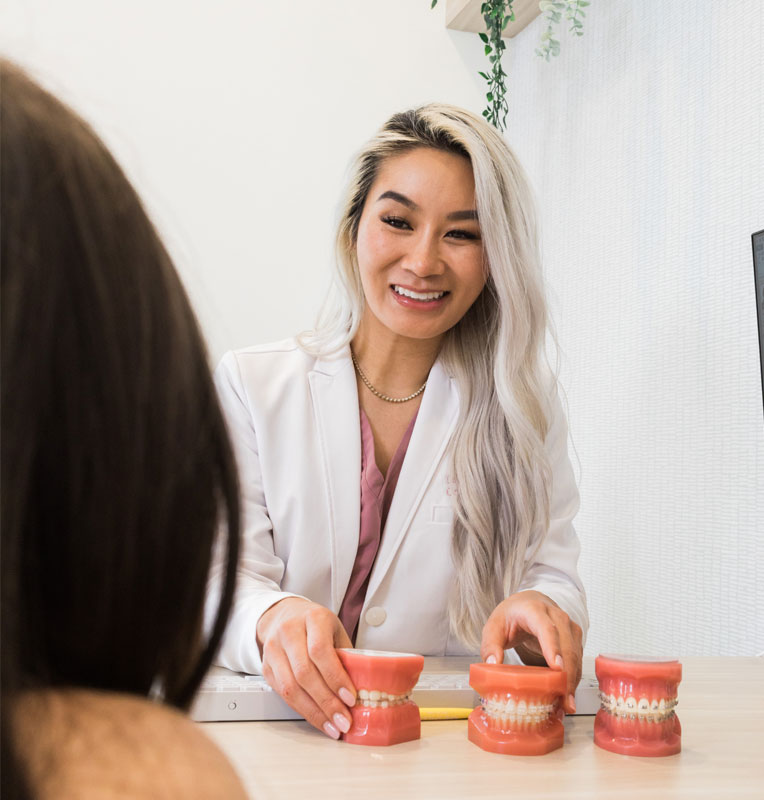
Thinking about straightening your teeth without ever stepping into a dental office? The clear aligner market has exploded over the past decade, with mail-order brands now competing directly with traditional orthodontic care. You can order trays from your couch or get them from an orthodontist’s office. But these two paths, at-home aligner brands vs in-office treatment, lead to very different experiences and outcomes.
What Are At-Home Aligners vs. In-Office Treatment?
At-home aligners are mail-order clear trays made from self-taken impressions or kiosk scans, with treatment monitored remotely through photos. In-office treatment uses X-rays, 3D scans, and recurring visits with a board-certified orthodontist who supervises every stage. The core difference is clinical oversight, which shapes safety, outcomes, and the kinds of cases each model can handle.
At-home aligners are mail-order clear trays created from impressions you take yourself or from a scan at a retail kiosk. Companies like Byte, AlignerCo, NewSmile, and the successors to SmileDirectClub ship plastic trays directly to your door. You wear them according to instructions, and a remote dentist or orthodontist reviews your progress through photos you upload.
In-office treatment works differently. You visit a licensed orthodontist who takes diagnostic X-rays, creates 3D scans of your teeth, and examines your bite, jaw, and gums in person. Treatment options include Invisalign treatment, ClearCorrect, or traditional braces. Your orthodontist monitors your progress at regular visits and adjusts your plan when needed. At KIND SMILES Orthodontics & Pediatric Dentistry, board-certified specialists handle every step in person.
The core difference comes down to clinical oversight. At-home brands skip the full exam, the X-rays that reveal root health and bone structure, and the hands-on supervision that catches problems early. According to the American Association of Orthodontists, moving teeth is a medical procedure that requires proper diagnosis and monitoring to be done safely.
That oversight gap matters more than most people realize. A board-certified orthodontist completes two to three years of specialized training beyond dental school in tooth movement and jaw development. That expertise shapes every decision made about your care, from the angle of a tooth’s movement to the timing of each tray change. Mail-order models replace that expertise with software algorithms and photo reviews, which can miss what a trained eye would catch in seconds.
How Each Treatment Model Actually Works
At-home aligners rely on self-taken impressions and remote photo monitoring. In-office care uses X-rays, 3D scans, and recurring visits with a board-certified orthodontist. One model removes clinical oversight to lower the price; the other builds oversight into every step. Curious how each plays out in practice? Here’s the breakdown.
How Does the At-Home Process Work?
When you order at-home aligners, you receive an impression kit in the mail. You mix putty, bite down, and send your molds back to the company. Some brands offer scanning at partner locations instead. A dental professional, often not an orthodontist, reviews your impressions remotely and creates a treatment plan without ever examining you in person.
Your aligners arrive by mail, often the full set at once. You switch trays on a schedule, every one to two weeks in most plans. Progress monitoring happens through selfies you submit through an app. If something feels wrong or teeth aren’t tracking properly, your options are limited to virtual messages with customer service or remote providers.
That’s it. No exam. No X-rays. No in-person follow-up.
The In-Office Process
In-office treatment starts with a free consultation where your orthodontist examines your teeth, takes X-rays, and creates detailed 3D scans. These diagnostics reveal what’s happening beneath your gums: root length, bone density, jaw alignment, and airway considerations that photos simply cannot capture.
Your orthodontist designs a custom treatment plan based on this complete picture. During treatment, you return every six to ten weeks for visits. These visits allow your provider to:
- Verify teeth are moving as planned
- Place or adjust attachments that help with difficult movements
- Perform interproximal reduction (IPR) when teeth need reshaping
- Catch complications like root resorption before they become serious
- Modify your plan if your teeth respond differently than expected
Tooth movement requires precisely calibrated forces. What works for one person may cause damage in another. Hands-on monitoring matters, and that’s why the KIND SMILES family builds it into every plan.
Documented Benefits of Each Approach
Both treatment models offer genuine advantages. Being honest about what each does well helps you make an informed choice.
What Do At-Home Aligners Offer?
At-home aligners appeal to many people for understandable reasons:
- Lower upfront cost. Prices fall well below in-office treatment.
- Convenience. No office visits mean no time off work or arranging childcare.
- Fast start. You can begin treatment within weeks of ordering.
- Privacy. Treatment happens entirely at home.
For someone with very mild spacing or minor crowding, healthy gums, and no bite issues, at-home aligners might deliver acceptable results.
Why In-Office Treatment Stands Apart
In-office orthodontic care offers capabilities that mail-order aligners cannot match:
- Full diagnosis. X-rays and clinical exams reveal problems invisible to cameras.
- Complex case capability. Bite correction, tooth rotation, and extraction cases require in-person care. Practices like KIND SMILES handle the full range of clear aligners cases, from mild crowding to surgical orthodontics.
- Real-time adjustments. Your orthodontist can change course when needed.
- Complication prevention. Early detection of root resorption, gum recession, or TMJ issues protects your long-term health.
- Refinements included. Most providers include additional aligners at no extra charge if teeth need fine-tuning.
Professional consensus, supported by guidance from the American Association of Orthodontists, holds that in-office aligners successfully treat conditions at-home brands explicitly exclude from their candidacy guidelines, including overbites, underbites, crossbites, and severe crowding.
Head-to-Head: At-Home Aligner Brands vs In-Office Treatment
When you look at published research and professional guidance, clear patterns emerge about how these two approaches perform. It’s worth restating that in-office care is delivered by board-certified orthodontists, specialists who complete two to three years of advanced training beyond dental school in tooth movement and craniofacial growth. That credential anchors the comparisons below.
What Are Professionals Warning About?
The American Association of Orthodontists issued a consumer alert in 2020 specifically warning about risks tied to unsupervised aligner therapy. The AAO noted that moving teeth without proper diagnosis can lead to irreversible damage including tooth loss, gum problems, and bite changes that require extensive correction.
Treatment Completion Rates
General professional consensus, reflected in AAO consumer guidance, points to higher rates of unfinished treatment among mail-order aligner users. Some families abandon treatment, require professional intervention mid-course, or finish with results that don’t match their expectations.
Patient Satisfaction
Reports from clinical observation suggest that those who complete in-office treatment tend to report better final alignment and higher satisfaction with their results. This makes sense when you consider that in-office families receive refinements as part of their treatment, while at-home users frequently face additional costs for touch-up trays.
Complication Rates
Clinical reports point to higher rates of complications among unsupervised aligner users, including:
- Unexpected bite changes
- Tooth mobility
- Gum recession
- Root resorption
- TMJ discomfort
These problems frequently go undetected until they become serious because remote monitoring through photos cannot identify early warning signs.
How Do They Compare Side by Side?
| Factor | At-Home Aligners | In-Office Treatment |
|---|---|---|
| Initial Diagnosis | Self-impression or kiosk scan | X-rays, 3D scan, clinical exam |
| Case Complexity | Mild crowding/spacing only | Mild to severe, including bite issues |
| Monitoring | Photo uploads, remote review | In-person visits every 6-10 weeks |
| Refinements | Additional cost | Typically included |
| Complication Handling | Limited to virtual support | Immediate in-person intervention |
| Insurance Acceptance | Limited | Broadly accepted |
| HSA/FSA Eligible | Sometimes | Yes |
Cost Factors: What’s Bundled and What’s Sold Separately
The price tag you see advertised covers different things depending on which model you choose. Some fees bundle diagnostics, refinements, and retainers; others charge for each piece separately. Knowing what’s included reveals the real difference between sticker price and total spend.
What At-Home Aligner Pricing Includes
Industry reports suggest at-home aligner treatment runs in the lower range of clear aligner pricing. The fee includes your aligners and basic remote monitoring. What it leaves out:
- Retainers. Essential for maintaining results, usually sold separately.
- Refinement aligners. If teeth don’t track properly, additional trays cost extra.
- Corrective treatment. If results fall short, you may need professional orthodontic care anyway.
When families need professional intervention after at-home treatment fails or causes problems, they frequently spend more than they would have on in-office care from the start. The KIND SMILES family sees this scenario regularly when families come in for evaluation after mail-order treatment.
In-Office Treatment Pricing
In-office clear aligner treatment lands in a higher range, with the exact figure depending on case complexity and geographic location. Industry reports suggest the full fee covers:
- Initial consultation and diagnostic records
- All aligners for the duration of treatment
- Attachments and IPR as needed
- Regular monitoring visits
- Refinement aligners if teeth need adjustment
- Retainers upon completion
How Can You Make Treatment Affordable?
Many orthodontic practices, including KIND SMILES, offer financing options that bring monthly payments closer to at-home aligner costs. When you factor in everything that’s included with in-office care, the value picture shifts considerably.
| Cost Element | At-Home | In-Office |
|---|---|---|
| Base Treatment | Lower range | Higher range |
| Diagnostics | Not included | Included |
| Refinements | Additional cost | Included |
| Retainers | Often separate | Usually included |
| Complication Care | Not covered | Included |
| Insurance Coverage | Limited | Broader acceptance |
Who Is Actually a Candidate for Each Option?
Not everyone qualifies for every treatment type. Understanding candidacy requirements protects you from starting something that won’t work.
Who Qualifies for At-Home Aligners?
At-home aligner companies target a narrow population:
- Adults with fully erupted permanent teeth
- Minor crowding within a small range
- Minor spacing issues
- No bite problems (overbite, underbite, crossbite, open bite)
- Healthy gums with no active periodontal disease
- No missing teeth requiring space closure
- No dental work that affects tooth movement (implants, bridges)
If you fall outside these parameters, at-home aligners aren’t designed for you, even if the company’s online screening tool says otherwise. At KIND SMILES, board-certified orthodontists evaluate each case to identify when at-home models simply won’t deliver the right outcome.
Who Should Skip At-Home Aligners
A few situations make at-home treatment inappropriate or genuinely risky. Bite issues require careful diagnosis and precise correction that photos can’t support. Moderate to severe crowding involves complex movements that need professional oversight. Active gum disease is a deal-breaker because moving teeth in unhealthy tissue accelerates bone loss. Prior dental work creates another challenge: implants don’t move, and treatment planning has to account for that. TMJ dysfunction can worsen if your bite is changed without a proper evaluation. And children and teens need specialized care, growth monitoring, and airway assessment that no app can replicate. The KIND SMILES family handles each of these scenarios in-house.
Who Qualifies for In-Office Treatment?
Board-certified orthodontists treat the full spectrum of cases:
- Mild to severe crowding and spacing
- All types of bite problems
- Cases requiring tooth extraction
- Complex movements including rotation and intrusion
- Families dealing with gum disease (in coordination with a periodontist)
- Children, teens, and adults
- Surgical orthodontic cases
What’s the Only Way to Know for Sure?
Self-screening through an app or website cannot replace a clinical examination. X-rays reveal root structure, bone health, and conditions that affect treatment safety. A proper free consultation with an orthodontist gives you an accurate picture of your options and what each will realistically achieve. That clinical perspective, paired with the specialized training of a board-certified orthodontist, is what separates a guess from a real plan.
Frequently Asked Questions
Are at-home aligners safe?
At-home aligners carry higher complication risk than supervised treatment. The American Association of Orthodontists warns that unsupervised treatment can cause irreversible damage, including tooth loss, root resorption, and bite problems, because proper diagnosis is skipped entirely.
Do at-home aligners actually work?
For very mild cases that truly fit the narrow candidacy criteria, at-home aligners can produce some improvement. However, professional consensus points to higher rates of incomplete treatment and dissatisfaction compared to in-office care. Many families need professional touch-up work after finishing their at-home trays.
Can I switch from at-home aligners to in-office treatment?
Yes, and many families do. If your at-home treatment delivers incomplete results or causes problems, an orthodontist can evaluate your current situation and create a plan to finish properly. You’ll essentially be starting fresh with proper diagnostics, which is why many people wish they’d chosen in-office care initially.
Why does in-office treatment cost more?
The higher fee reflects what’s included: full diagnostics with X-rays and 3D scanning, a custom treatment plan designed by a specialist, regular monitoring visits, the ability to adjust course when needed, refinement aligners, and complication management. You’re paying for expertise, oversight, and accountability throughout your treatment.
Does insurance cover at-home aligners?
Coverage for at-home aligners is limited compared to in-office orthodontic treatment. Most dental insurance plans with orthodontic benefits cover treatment provided by licensed orthodontists, which is why offices like KIND SMILES can verify benefits and apply them directly to your care. HSA and FSA accounts can sometimes be used for at-home aligners, but verification is important before purchasing.
How do I know which option is right for me?
A free consultation with a board-certified orthodontist gives you a clear, unbiased answer. During this visit, you’ll receive a thorough examination, see exactly what’s happening with your teeth and bite, and learn which treatment options can achieve your goals. This information helps you make the right choice for your situation, even if that choice ends up being at-home aligners for a truly mild case. At KIND SMILES Orthodontics & Pediatric Dentistry, we sit down with each family, walk through every option in plain language, and help you choose what genuinely fits your smile and your life.