
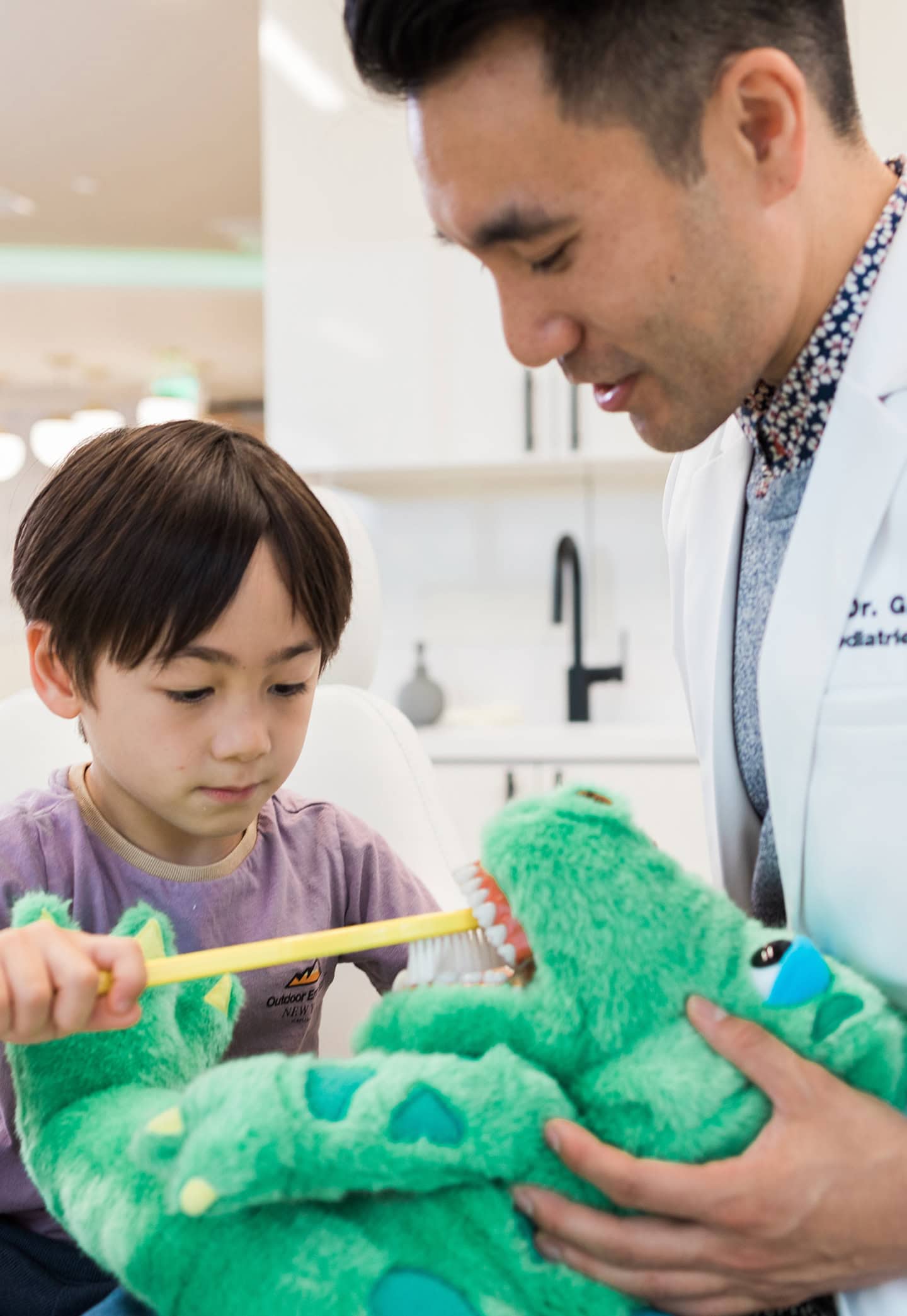
A crown on a baby tooth is recommended when decay is too large for a filling to hold. The crown caps and protects the tooth so your child can chew, speak and hold space for the adult tooth until the baby tooth falls out.
Hearing that your child needs a crown can be a surprise, especially on a tooth that is going to fall out anyway. It is one of the most common questions parents ask us after an exam. This guide walks through why baby teeth are worth saving, how we decide between a filling, a crown and an extraction, what the appointment is like and how to look after the tooth afterward.
Why Fix a Baby Tooth That Will Fall Out Anyway?
Baby teeth (primary teeth) do more than fill a smile for a few years. Some of the back molars stay in place until the pre-teen years, so a cavity found at age four can be sitting in your child’s mouth for a long time if it is left alone.
The biggest reason to save them is space. Each baby tooth acts as a placeholder for the permanent tooth growing underneath it. If a baby molar is lost early, the teeth on either side tend to drift into the gap. The adult tooth can then run out of room and come in crooked or blocked, which can mean more orthodontic work later.
Decay is the other reason. Tooth decay is one of the most common chronic childhood illnesses, and a cavity does not heal on its own. Left untreated, it keeps growing. It can reach the nerve of the tooth, cause pain or infection and spread to the neighboring teeth. Treating it while the tooth can still be saved is almost always easier on your child than waiting for a toothache.
Healthy baby teeth also let children chew a full range of foods, form sounds clearly as they learn to talk and smile without feeling self-conscious. Keeping them healthy until they are ready to go is the whole goal of pediatric restorative care.
When Does a Baby Tooth Need a Crown Instead of a Filling?
Most cavities that are caught early can be fixed with a simple filling. A crown comes into the picture when there is not enough healthy tooth left for a filling to stay put.
A filling replaces a small decayed area and relies on the tooth around it for strength. When decay has spread across several surfaces of a molar, or the tooth has started to break down, a large filling is likely to crack or fall out. A crown covers the whole tooth, so it protects what is left from every side.
Depth matters too. If decay has gone far enough to reach the inner part of the tooth, the tooth usually needs extra treatment before it is restored, and a crown is the usual way to protect it afterward. Dr. Gary will explain exactly what your child’s tooth needs and why, using the X-rays from the exam.
We avoid extractions whenever possible. Sometimes, though, a tooth is too badly damaged or infected to keep, and removing it is the healthiest choice. When that happens, we talk with you about whether a space maintainer is needed to hold the gap open for the adult tooth.
What Are the Signs a Baby Tooth Needs Treatment?
Cavities in baby teeth often start quietly. By the time a child complains, the decay has usually been growing for a while, which is one reason a crown rather than a small filling ends up being needed. A few things parents can watch for at home:
- Brown, gray or black spots, or a visible hole in a tooth
- Chalky white patches near the gumline, an early sign of weakened enamel
- Wincing at cold drinks, ice cream or sweets
- Chewing on one side only, or suddenly avoiding foods your child used to like
- A pimple-like bump, swelling or redness on the gum next to a tooth
- Food that keeps getting packed into the same spot between back teeth
Not every cavity shows up on that list. Many cavities in baby molars start between the teeth, where neither you nor your child can see them. X-rays taken at an exam show how far decay has gone and how close it is to the nerve. That is exactly the information we need to choose between a filling, a crown and an extraction, and it is why a tooth that looks fine on the surface can still need a crown underneath.
Some signs should not wait for the next routine visit. Pain that wakes your child at night, swelling in the face or gums, or a fever with a sore tooth all mean it is time to call the office so we can see your child promptly.
Filling, Crown or Extraction: How Do the Options Compare?
This side-by-side view is a general guide to how the three treatments differ. Your child’s exam and X-rays decide which one fits.
| Filling | Crown | Extraction (with space maintainer if needed) | |
|---|---|---|---|
| Used when | A small or early cavity | Decay too large for a filling, or a weakened tooth | The tooth cannot be saved |
| What it does | Replaces the decayed part of the tooth | Caps and protects the entire tooth | Removes the tooth; a maintainer can hold the space |
| Materials | Silver amalgam or tooth-colored composite resin | A custom protective cap shaped like the tooth | Maintainers are metal or acrylic, fixed or removable |
| How long it lasts | Many years with good care | Until the baby tooth falls out on its own | Maintainer stays until the adult tooth comes in |
| Keeps the natural tooth | Yes | Yes | No |
Fillings, crowns, space maintainers and extractions are the most common restorations we provide for children. Each one is explained in more detail alongside our other pediatric dental restorations.
What Happens at a Crown Appointment?
Parents tend to picture their own dental visits, which is one reason crowns sound bigger than they are. For children, we plan the visit around comfort first, and that starts at home. Talk about the visit in simple, positive words and avoid phrases like shot or hurt. If your child is nervous, tell us ahead of time. Our guide on helping a child who is scared of the dentist has practical scripts for the days before.
In the chair, our dental laser replaces the drill in the majority of our procedures. It is quiet and vibration-free, and in most cases we can treat cavities without an anesthetic injection, so there is no numb lip to chew afterward. You can see how laser dentistry works for kids before the visit.
Some children need more help relaxing. For them, we offer nitrous oxide (laughing gas), which keeps your child awake but calm, and IV sedation performed in our office, which lets your child sleep through treatment. Dr. Gary only recommends sedation when he believes your child will truly benefit, and he walks you through the pros and cons first.
The crown itself is straightforward. The decayed part of the tooth is removed, the tooth is shaped, and the crown is fitted and cemented in place so it covers the tooth completely. Many parents are surprised by how routine the appointment feels once it is underway.
How Do You Care for a Child’s Crown at Home?
A crown protects the tooth it covers, but the gumline around it and every other tooth can still get cavities. Good habits at home are what keep the next exam uneventful.
Brush twice a day with a soft toothbrush, paying attention to where the crown meets the gum. Help younger children brush, since most kids do not yet have the dexterity to clean their back molars well on their own. Floss between teeth that touch, including next to the crown.
What your child eats matters just as much. Limit sticky and sugary snacks and sipping sweet drinks throughout the day, since frequent sugar is what feeds decay. Very sticky candy can also tug at a crown. If your child grinds or chews on hard objects, mention it at the next visit.
Finally, keep up with routine pediatric dental exams. They let us check the crown, catch new cavities while they are small and keep an eye on how the adult teeth are coming in.
Frequently Asked Questions
Will my child’s crown fall out?
A crown on a baby tooth is designed to stay on until the tooth falls out naturally, and the crown comes out with it. If a crown ever feels loose or comes off early, call us so we can check it.
Does getting a crown hurt?
Most children feel very little. Our laser lets us treat many cavities without injections, and nitrous oxide or IV sedation are available for children who need more help. Some mild gum tenderness for a day or so is normal.
Can we just wait for the tooth to fall out?
Waiting is sometimes reasonable for a tiny cavity in a tooth that is about to come out. For a large cavity in a tooth with years left, waiting usually leads to pain, infection or an early extraction. Dr. Gary will tell you honestly which situation your child is in.
How do we pay for a crown without insurance?
We accept all major PPO plans. For families without dental insurance, our Kindness Club membership plan covers exams, cleanings, fluoride and X-rays for the year and includes a discount on additional pediatric treatment.
Book a Visit With Dr. Gary — Questions Welcome
If your child’s dentist has mentioned a crown, or you have noticed a dark spot or a tooth your child avoids chewing on, we are happy to take a look. Dr. Gary Liu is a board-certified pediatric dentist, and our Irvine office is built around making visits feel easy for kids. Book a pediatric appointment online or call us at (949) 561-1088.